Blogs
Stay updated with our latest blog posts.


A persistent myth among homeowners is that once August arrives, the cooling season is essentially over. Because of this misconception, choosing between replacing your AC vs. limping through the rest of the Texas summer often feels like a simple waiting game. You might assume that if your struggling unit can just hold on for a few more weeks, you can delay a major investment until next year. In our years of keeping Boyd homes cool, we've learned that the reality of our regional climate is far less forgiving, and banking on an early autumn is a gamble that rarely pays off.
When an aging cooling unit begins to fail during mid-summer peak Texas heat, it forces a critical decision point. You have to choose between paying for another temporary band-aid fix or investing in a full system replacement that provides lasting stability. Older systems do not simply run a little warmer; they actively deteriorate under the immense strain of consecutive 100-degree days. Every hour an older compressor runs in extreme heat, it draws more amperage, works harder to move refrigerant, and pushes degraded electrical components closer to total failure.
The physical toll on your equipment:
• Thermal overload: Components like capacitors and contactors degrade rapidly when ambient temperatures remain dangerously high for weeks on end.
• Continuous cycling: A failing system rarely shuts off, meaning the blower motor and compressor endure non-stop friction and heat buildup.
• Lubrication breakdown: The oil inside an older compressor loses its viscosity over time, leading to metal-on-metal grinding during peak operation.
Making the right choice requires looking beyond the immediate week ahead. A reliable network of air conditioning systems is the only barrier between your living room and dangerous outdoor temperatures. If you find yourself constantly adjusting the thermostat just to keep the house tolerable, it might be time to consider professional AC replacement in Boyd rather than crossing your fingers and hoping the machinery survives another heatwave.
Evaluating the financial realities of an inefficient unit requires looking past the immediate price of a service visit. The true cost of keeping a failing air conditioner on life support includes the inflated utility bills that quietly drain your bank account every month. As aging units lose their cooling capacity, they are forced to run longer cycles just to maintain a basic level of comfort. This loss of efficiency means you are paying significantly more money for significantly less cooling power.
During extreme July heat waves in Boyd TX, a poorly maintained system might run for 18 to 20 hours a day. The electrical draw of a struggling compressor is massive. What you save by delaying a replacement is often lost to the utility company through astronomical energy costs. Furthermore, temporary fixes rarely address the root cause of the system's decline. A pattern our technicians see often is homeowners paying for repeated service calls, refrigerant top-offs, and minor part swaps that quickly add up to a substantial financial burden.
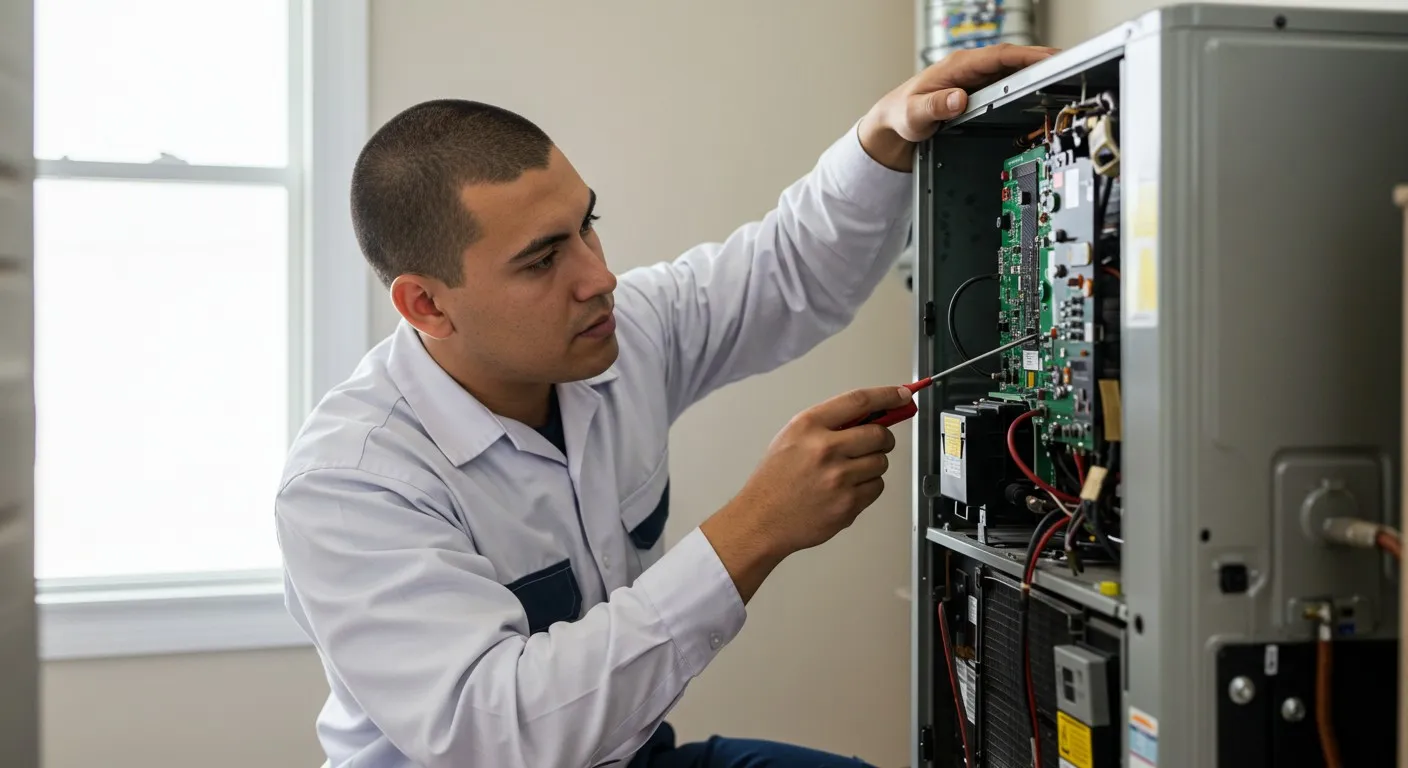
One local homeowner we recently assisted experienced this exact situation when their system stopped working entirely during triple-digit temperatures. While our prompt technician was able to diagnose the issue and perform the necessary AC repair services within an hour to restore cooling, relying on emergency visits for an aging system is stressful. When a unit is already compromised, one repaired part simply shifts the operational stress to the next weakest component in the chain.
Opting for a temporary patch on a dying system often sets the stage for a cascading failure. Air conditioning systems operate as closed, balanced loops. When one component underperforms, the rest of the system works overtime to compensate. Our team at Family Comfort Heating & Air frequently encounters the aftermath of these cascading failures:
• Failing capacitors: A weak capacitor fails to deliver the necessary jolt of electricity to start the compressor. The compressor then draws excessive current, overheating its internal windings until it burns out completely.
• Refrigerant leaks: Topping off a leaking system without fixing the underlying hole means the compressor will eventually run dry, leading to catastrophic mechanical failure.
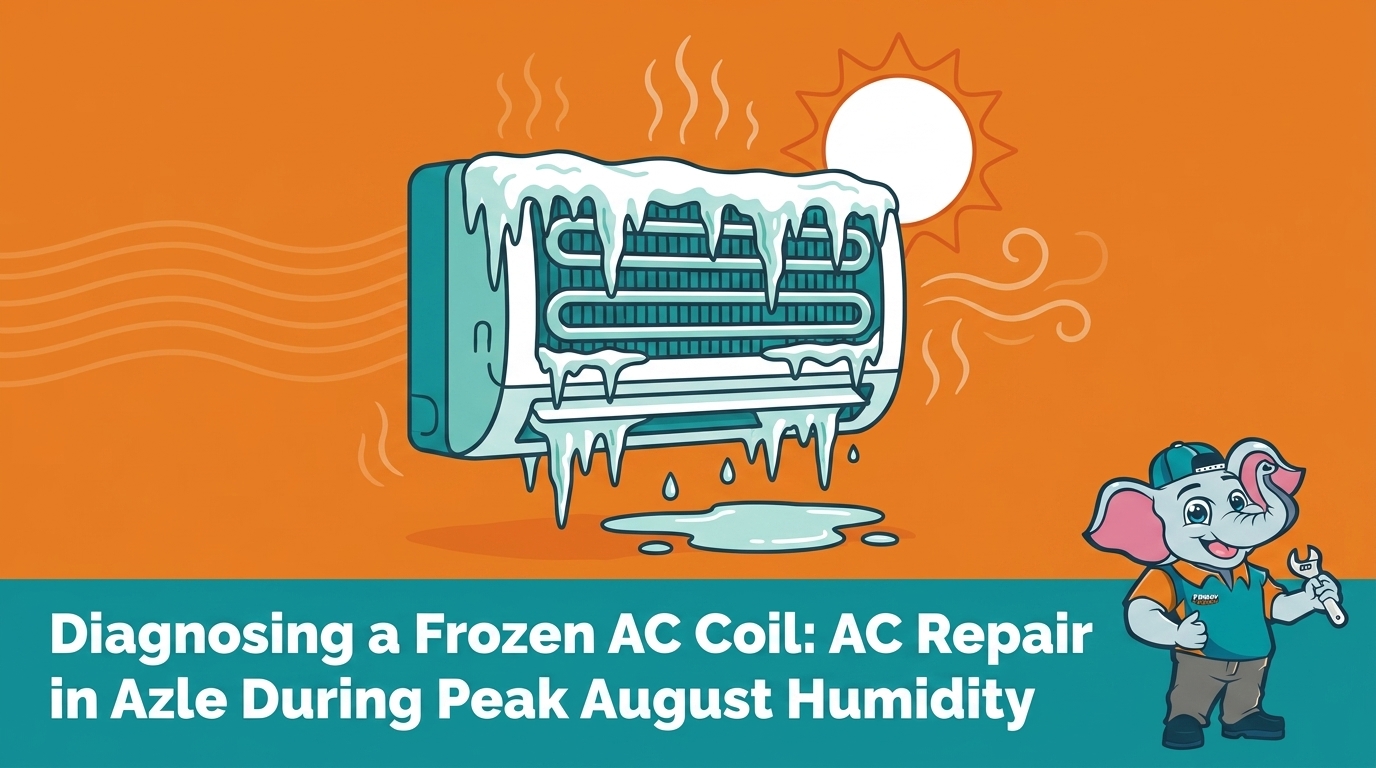
• Airflow restrictions: A struggling blower motor can cause the evaporator coil to freeze over, which can send liquid refrigerant back to the compressor, destroying it instantly.
Extreme temperatures accelerate the deterioration of these already compromised parts. What begins as a minor rattle or a slightly elevated energy bill can quickly escalate into a total system shutdown exactly when you need cooling the most.
To make an informed decision about your HVAC equipment, you must factor in the actual duration of the local cooling season. The Texas heat does not respect the calendar. While retail stores might start putting out autumn decorations in August, September and October routinely demand peak cooling performance from your equipment. Deciding to limp through the rest of the season actually means asking a failing machine to survive three to four more months of heavy operational load, not just a few weeks.
Historical climate data for the region shows that extreme heat advisories and high cooling degree days extend deep into the fall. A "cooling degree day" is a measurement used to quantify the demand for energy needed to cool a building. In Boyd TX, these numbers remain stubbornly high long after the official end of summer. In our experience servicing North Texas homes, an air conditioner that is barely scraping by in early August will likely collapse under the sustained pressure of a sweltering September afternoon.
Regional climate factors to consider:
• Sustained overnight heat: Systems rarely get a chance to cool down and recover because nighttime temperatures often remain uncomfortably warm.
• Grid strain: High regional demand during prolonged heatwaves can lead to voltage drops, which force struggling compressor motors to work even harder to start and run.
• Humidity spikes: Late summer storms bring elevated humidity, forcing your system to run longer cycles to dehumidify the air before it can effectively lower the temperature.
Upgrading to a modern, high-efficiency system provides much-needed resilience against these extended heat waves. A new unit operates with lower electrical resistance and better heat transfer capabilities, ensuring your home stays comfortable regardless of how long the extreme weather decides to linger.
While efficiency ratings and repair bills are easy to quantify, the most important factors in this decision are the safety, comfort, and mental well-being of your household. Enduring a total system breakdown during dangerous mid-summer peak Texas heat takes a severe physical and emotional toll. The anxiety of waiting for the next mechanical failure can make your own home feel like a stressful environment rather than a sanctuary.
Before an older unit completely fails, its performance degrades in ways that impact your daily life. Indoor air quality plummets as the system struggles to filter out dust and allergens. Humidity control is often the first casualty of a failing system, leaving your living spaces feeling sticky, damp, and uncomfortable even if the thermostat reads an acceptable temperature. This excess moisture can encourage mold growth and exacerbate respiratory issues.
Another local family recently faced the harsh reality of a total breakdown, finding themselves with no cooling for a week with toddlers in the middle of a dangerous July heatwave before reaching out to us for expedited service. No family should have to endure those conditions. At Family Comfort, our ethos is built on providing honest, family-first advice. We prioritize your family's safety above all else, which means helping you avoid wasting hard-earned money on doomed repairs when a replacement is the only reliable path forward. Valuing peace of mind over the stress of constant breakdowns is a perfectly valid reason to upgrade your equipment today.
Choosing to replace your failing equipment mid-season unlocks immediate benefits that begin paying dividends the moment the new system is turned on. When our installation team replaces a 10-to-15-year-old air conditioner with a modern, high-efficiency model, we typically see our customers reduce their cooling energy usage by 20% to 40%. When you apply those percentages to the inflated utility bills of a Boyd TX summer, the month-over-month savings are substantial.
Modern air conditioning technology has advanced significantly over the last decade. Today's systems are designed to manage extreme heat loads with incredible precision.
Technological advancements in modern cooling:
• Variable-speed compressors: Unlike older units that only run at 100% capacity or shut off entirely, variable-speed technology allows the compressor to adjust its output in tiny increments. This maintains a perfectly consistent indoor temperature while using a fraction of the electricity.
• Advanced coil designs: Newer evaporator and condenser coils feature enhanced surface areas and specialized materials that transfer heat much more effectively than older, degraded copper coils.
• Smart thermostat integration: Modern systems communicate seamlessly with smart controls, optimizing run times based on your daily schedule and real-time weather conditions.
Beyond the financial savings, a new system restores immediate reliability. You eliminate the constant anxiety of wondering if the house will be sweltering when you return from work. To ensure you get the absolute best performance from a new installation, it is critical to consult professionals about proper AC sizing for optimal home cooling. An accurately sized unit will dehumidify effectively, cool evenly, and operate at peak efficiency for years to come.
The primary barrier preventing most homeowners from upgrading their failing equipment mid-summer is the upfront financial commitment. It is completely natural to hesitate when comparing a massive installation invoice against a smaller, immediate repair bill. However, we always recommend evaluating this decision by looking at the total cost of ownership over the next few years, rather than just the immediate out-of-pocket expense.
When you choose to repair a dying unit, you are essentially renting a few more weeks of cooling. The continuous repairs, combined with grossly inflated energy bills, often eclipse the monthly cost of a new system much faster than people realize. Every dollar poured into a failing compressor or an obsolete R-22 refrigerant leak is a dollar you will never recover. Conversely, the money invested in a new, high-efficiency system immediately begins paying you back through lower utility statements and the elimination of emergency service fees.
You do not have to deplete your emergency savings to secure a reliable cooling system. Modern financial solutions make an immediate upgrade highly accessible. By utilizing flexible HVAC financing options, you can break the cost of a premium installation into predictable, manageable monthly payments. In many cases, the monthly energy savings generated by the new system offset a significant portion of the financing payment, making the upgrade far more affordable than suffering through the mid-summer peak Texas heat with a broken machine.
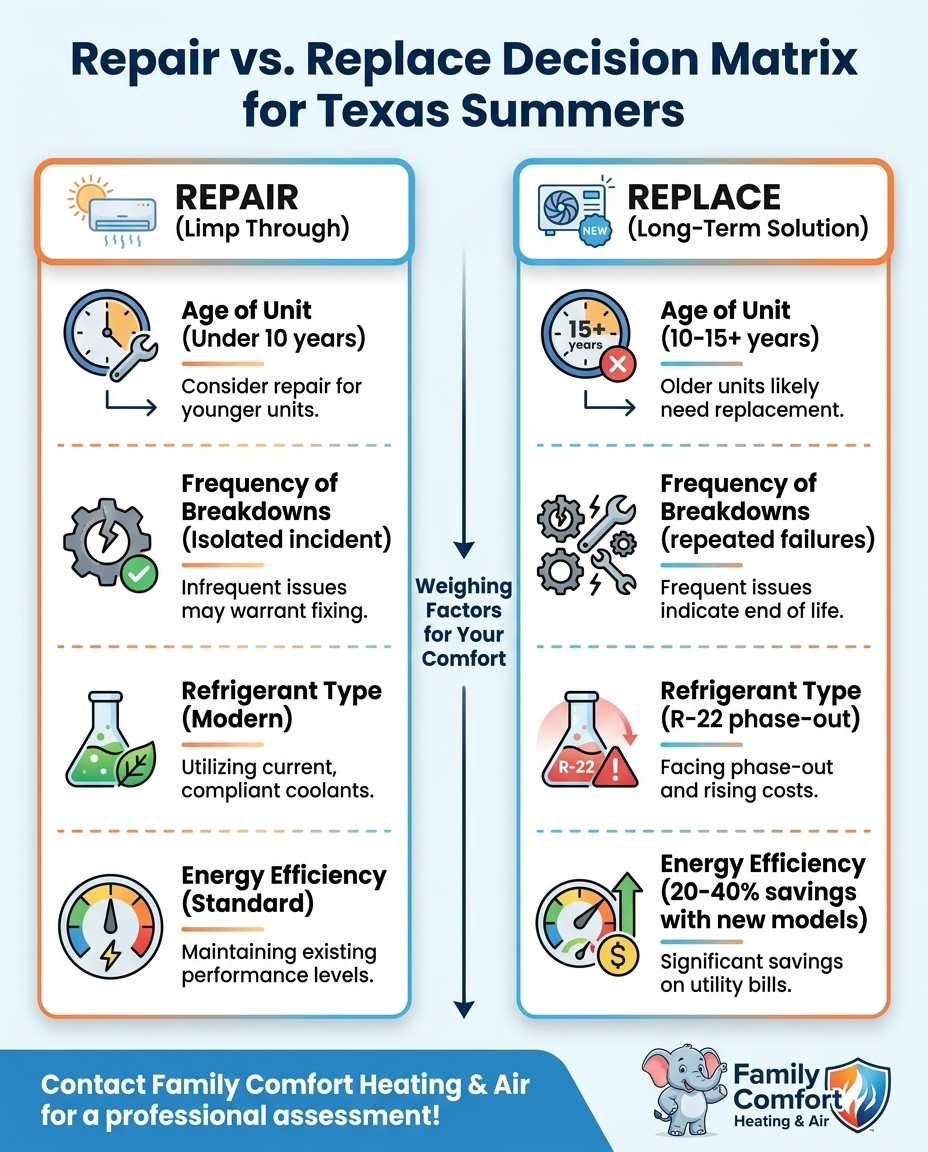
To help synthesize these factors, our technicians often share this clear, scannable comparison framework with our customers. When evaluating your equipment in Boyd TX, weighing these specific metrics can provide objective clarity during a stressful breakdown.
• Age of the System — Signs Pointing to Repair: Unit is under 10 years old and generally well-maintained. — Signs Pointing to Replacement: Unit is over 10-15 years old; nearing the end of its designed lifespan.
• Breakdown Frequency — Signs Pointing to Repair: This is an isolated incident or the first major repair needed. — Signs Pointing to Replacement: You have experienced multiple failures over the past two cooling seasons.
• Refrigerant Type — Signs Pointing to Repair: System uses modern, widely available R-410A refrigerant. — Signs Pointing to Replacement: System relies on phased-out R-22 (Freon), making leak repairs incredibly expensive.
• Long-Term Cost Impact — Signs Pointing to Repair: Repair cost is minor and will restore the unit to high efficiency. — Signs Pointing to Replacement: Repair is costly, and a new unit would provide 20-40% in energy savings.
• Warranty Status — Signs Pointing to Repair: Major components (like the compressor) are still fully covered under the manufacturer warranty. — Signs Pointing to Replacement: The warranty has expired, leaving you responsible for all parts and labor costs.
Our general rule of thumb at Family Comfort is that you should stop repairing your AC when the cost of the repair exceeds 50% of the value of a new system, or if the unit requires frequent service calls just to stay operational. Additionally, if your equipment is over 10 years old and uses phased-out R-22 refrigerant, sinking more money into it is rarely a wise investment. Transitioning to a new installation provides better long-term reliability and eliminates the stress of unpredictable mid-summer peak Texas heat breakdowns.
Based on the systems we service across the region, a well-maintained central air conditioning unit typically lasts between 10 and 15 years in the intense Texas climate. The extreme heat, high humidity, and extended cooling seasons force local systems to run significantly more hours per year than units in milder regions. Regular professional maintenance can help push a system toward the 15-year mark, but components inevitably degrade under the constant strain of consecutive 100-degree days.
It is generally better to replace an air conditioner if the unit is past its warranty, requires a major component like a compressor, and struggles to keep your home comfortable during extreme heat. Repairing makes sense for newer systems facing minor electrical or sensor issues. Having our professionals assess your system's overall health, efficiency rating, and repair history is the best way to determine which path offers the highest return on investment.
Yes, replacing a 15-year-old AC unit is highly recommended, especially if it is showing signs of reduced cooling capacity or frequent breakdowns. At 15 years old, the system is likely operating at a fraction of its original efficiency and utilizing outdated technology. Upgrading to a modern unit will drastically lower your monthly utility bills, improve your indoor air quality, and provide dependable comfort during the hottest months of the year.
Yes, a new AC unit will cool your house significantly faster and more consistently during a heatwave. Modern systems feature advanced compressors and optimized airflow designs that remove heat and humidity from your home with exceptional efficiency. Because a new unit operates at its peak rated capacity, it can overcome extreme outdoor temperatures much easier than an aging system that has lost its cooling power over time.
Navigating an unexpected equipment failure during the hottest part of the year is incredibly stressful, but having a clear, objective decision framework makes the process easier. Weighing the immediate costs of band-aid repairs against the upfront reliability and long-term energy savings of a modern system reveals the best path forward. You do not have to suffer through the heat or settle for a house that never quite gets cool enough.
Take control of your indoor environment and secure a long-term solution that protects your household. Reach out to our team today for a comprehensive, honest assessment of your current equipment. We will help you determine if a repair makes sense, or guide you through the process of AC replacement in Boyd so you can enjoy reliable, efficient cooling for years to come.


Stay comfy with 0% Financing for 12 Months on a new HVAC system through Synchrony and Wisetack! No hidden fees, no stress—just easy payments.